A reorder point is the stock level where you place a new order, set high enough that what is left covers the wait for the next delivery. After Stocky, the thing to understand first is what a reorder point is for: it is a planning input you decide and review, not an automatic purchase instruction the system carries out for you. Shopify records your stock, your orders, and your sales, and it can show you how long stock is likely to last, but it does not watch a product and reorder it when the number gets low. That decision stays with you. This guide explains what a reorder point is, the inputs that go into one, where Shopify shows the numbers you need, and how to turn that into a short list of what to reorder next, all without Stocky in the loop.
What a reorder point is
A reorder point is a single number per product: the quantity at which you should place your next order so you do not run out while you wait for it to arrive. Treat it as an early warning line rather than a target stock level. When the units on hand fall to that line, it is time to buy, because the stock that remains is meant to last exactly as long as the supplier takes to deliver. Two things drive the line. The first is how fast the product sells, measured as units per day over a recent period. The second is how long the supplier takes to deliver once you place the order, known as the lead time. A reorder point that ignores either one is really a guess. The point of writing it down is to turn a vague sense of running low into a number you can act on the same way every time, for every product, instead of reacting once a shelf already looks empty. Reaching the reorder point is the trigger, not the order itself: the item moves onto a Shopify buy list after Stocky, where you confirm it still needs buying and decide how much before a purchase order exists.
What changes when Stocky is no longer your planning workflow
Reorder points are not new, but where you work them out changes when Stocky retires. Stocky will not be available after August 31, 2026, and from that date you manage inventory in the Shopify admin and Shopify POS instead. Two details matter for reorder planning. Historical Stocky data, including old purchase orders and stocktakes, will not move into Shopify automatically, so any sales history you want to base a reorder point on has to be exported while Stocky still runs. And Shopify notes that some Stocky-specific features might work differently or might not yet be available in Shopify, so do not assume a feature-for-feature swap. For the full set of dates, see the Stocky shutdown timeline. The reorder math stays the same. What changes is that the inputs now come from the Shopify admin and from a planning layer you keep yourself.
The reorder point formula: demand over lead time plus safety stock
The simplest reorder point has two parts you add together. The first part is demand during lead time: how many units you expect to sell between placing an order and receiving it. If a product sells about four units a day and the supplier takes ten days, demand during lead time is roughly forty units. The second part is safety stock: a buffer for the days the product sells faster than usual or the supplier delivers later than promised. Add the two, and the sum is your reorder point. Using the same example, forty units of expected demand plus a buffer of fifteen gives a reorder point of fifty-five. When stock on hand reaches fifty-five, you reorder. Safety stock is a judgement call, not a formula output. A steady seller from a reliable supplier needs little, while a variable seller or a supplier who slips needs more. Keep the buffer honest, because too much safety stock just ties up cash in inventory that could have gone to products that turn over faster.
Why a reorder point needs context, not just a number
A reorder point is only as good as the inputs behind it, and those inputs drift. Four of them deserve a second look before you trust a number. Sales velocity changes with seasons and promotions, so a line set in a quiet month can be far too low in a busy one. Current stock on hand has to be accurate, because the reorder point means nothing if the count is wrong. Open purchase orders matter too: stock already on its way should count toward covering demand, or you will double-order. And some restocks are not purchases at all but moves between your own locations, which is a separate decision covered in reorder versus transfer. Shopify can help with the velocity side. Its inventory reports summarize past sales and current stock to help you decide what to prioritize when restocking, and the days of inventory remaining figure estimates how long stock will last based on average sales rates, calculated as the ending quantity divided by the average quantity sold per day. Those reports are a useful prompt, but they are not automatic reorder recommendations and do not calculate reorder quantities for you, so the reorder point itself is still yours to set. For the running view of how long current stock will last, see days of inventory remaining.
What Shopify shows natively, and what still needs a planning layer
Start with what the Shopify admin already gives you, because it holds most of the raw numbers a reorder point needs. Inventory CSV files can export your current quantities and update quantities for products in each location, and the On hand column is what sets the units physically present at a location, so a CSV export is a quick way to pull the stock-on-hand side of every reorder point at once. A Shopify purchase order lets you record what you order from a supplier, including the products, quantities, prices, payment terms, and an estimated arrival date that you enter manually, which is where your open-order and lead-time history lives. For what those native purchase orders cover after Stocky, and what they leave to your planning layer, see Shopify purchase orders after Stocky. What the admin does not do is the planning itself. It will not flag which products have reached their reorder point, roll many products into one buying plan, or set the safety stock for you. There is also a hard limit worth knowing: purchase order APIs are not currently available in Shopify and are under consideration, so you cannot fully automate purchase order creation from an outside system today. That gap is why the what, when, and how much sit in a planning layer, which for most stores starts as a spreadsheet built from these exports. The step-by-step of keeping stock topped up is covered in inventory replenishment after Stocky.
How supplier lead time changes the reorder decision
Lead time is the input that breaks the most reorder points, because it is the one you do not control. A reorder point is sized for a delivery window, so when a supplier runs late, a line that looked safe turns into a stockout: the buffer was built for a wait the supplier did not keep. The fix is to treat lead time as a real, per-supplier number rather than one guess applied to everyone. A supplier who is reliably quick lets you hold a lower reorder point and less safety stock. A supplier who slips needs a longer assumed lead time and a bigger buffer, which costs you in held inventory but protects the sale. Shopify purchase orders record what you ordered from each supplier and let you track and manage those orders, so they give you the order history you can review before placing the next reorder. Turning that history into a reliability read, an on-time rate and a typical lead time per supplier, is one more job that sits in the planning layer rather than inside the admin. Reading that timing across items before each buy is the focus of supplier lead time in reorder planning.
Where a dedicated reorder planner fits
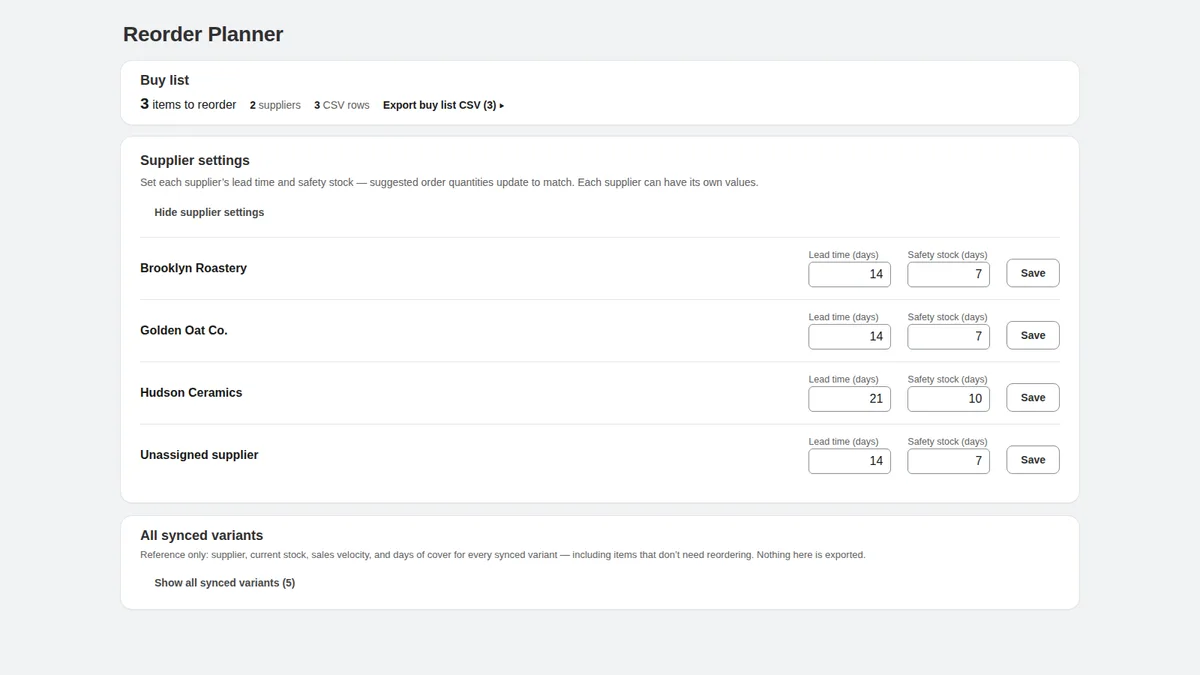
When the planning layer outgrows a spreadsheet, a focused tool is one way to hold it, and a dedicated reorder planner now exists for this exact step. Kijun Reorder Planner is aimed at the reorder-list job: it builds supplier buy lists from recent sales and stock, groups reorder items by supplier, and lets you adjust quantities before exporting — you can save buy lists for later, and export CSV/PDF buy lists when the numbers look right. It helps to be plain about what it is not. It is read-only by design: it does not create Shopify purchase orders, which stay native to Shopify, it does not write inventory changes back, it does not use customer names, emails, phone numbers, addresses, or payment data, and it does not forecast demand. Kijun Reorder Planner is available on the Shopify App Store, and nothing in this guide depends on it. For the wider what, when, and how much decision, the hub for this topic is reorder planning after Stocky.
What to do before August 31, 2026
The reorder points you set after the cutover depend on history that is far easier to pull while Stocky still runs, so the order of operations matters. Export your sales history, current counts, and any past purchase orders before the deadline, because that data will not move into Shopify on its own afterward. Rebuild your purchase order process in the Shopify admin so the team knows where ordering happens now. Then set a first reorder point for your top sellers, even a rough one, and a simple way to see when stock crosses it, starting with a single spreadsheet fed by your CSV exports. Checking that spreadsheet on a fixed weekly cadence turns scattered low-stock alerts into one short review; a weekly reorder list is one way to run it. You do not need every product on day one. The fast movers are where a missed reorder costs the most, so start there and widen the list over time. For the wider question of which tools to move to after Stocky, see what to use after Stocky. Put the export step on the calendar now, because read-only export access runs only for a limited period after the cutoff and the app stops being usable for day-to-day work on that date.
Limitations
This guide is a way to set reorder points after Stocky, not a guarantee about results, and it is not meant to cover every workflow Stocky used to support. A reorder point is a judgement call you make from your own sales history and supplier behaviour, so treat any calculated line as a starting point a person reviews, not an instruction to follow blindly. Purchase order creation stays native to Shopify, and none of this is demand forecasting. For the one input where supplier reliability is the heart of the decision, the existing kijun app is one option, scoped honestly: it turns purchase orders recorded in the app into 0-100 supplier scorecards, on supported supplier and vendor records, and it does not forecast demand or reorder for you. See how supplier scorecards work after Stocky.
This article was drafted with AI assistance and checked against cited sources through kijun’s editorial workflow. Last updated: 2026-07-03.
Stocky and Shopify are trademarks of Shopify Inc. kijun is not affiliated with or endorsed by Shopify.