A buy list is the review step between your inventory numbers and a Shopify purchase order. After Stocky, it is the working list where you decide what to buy, how much, and why, before any order is created in the Shopify admin. The list is not a native Shopify feature. It is a planning artifact you keep yourself, built from the counts and sales history that Shopify already holds. The job of this guide is to make that list safe to act on: to put the right items on it, size each quantity from real numbers, and catch the weak orders before they become purchase orders. Stocky will not be available after August 31, 2026, and from that date you manage inventory in the Shopify admin and Shopify POS, so a buy list is also how you keep buying decisions organized once the old workflow is gone. Here is what a buy list should do, and how to review one before you order.
- Reorder signal An item crosses its reorder point or is getting tight on cover.
- Review stock, recent sales, days of cover, and lead time Start each row from real numbers, not memory.
- Build the buy list Decide what to buy, how much, and why now.
- Group it supplier-ready Organize the rows by supplier and note who tends to run late.
- Create the Shopify purchase order The native admin record captures a decision you already made.
What a buy list should do after Stocky
A buy list is a decision document, not a record. It sits in front of the purchase order and answers three questions for each item: what to buy, how much, and why now. The purchase order that follows is where the decision gets written down once it is made, so keeping the two apart is what stops the move off Stocky from feeling harder than it is. After the cutoff, inventory tasks such as transfers, purchase orders, inventory quantity adjustments, and historical reporting are handled in the Shopify admin, which means the admin holds the order records and the stock numbers. What it does not hand you is the short list of items that need a buying decision this week. That short list is the buy list, and it is the part you own. Treat it as the place where reorder planning becomes concrete, the bridge between the wider question of reorder planning after Stocky and the single order you are about to place.
Start with the items that actually need a buying decision
A useful buy list is short. Most of your catalogue does not need an order in any given week, so listing everything buries the few items that matter under the many that do not. Start by pulling the products that are close to running low or already past the point where you would normally act, and leave the rest off until they get there. The aim is a list you can review in one sitting, where every row has a reason to be there. A product with months of cover does not belong on this week’s buy list, and neither does a slow seller you are trying to run down, so flagging slow-moving inventory before it earns a row keeps the list short. Building the list this way also makes the later checks faster, because you are only sizing quantities for items that have already earned a place. If you are not sure which products qualify, the running view of what is getting low is the subject of inventory replenishment after Stocky, and the buy list is where that view turns into specific orders.
Check inventory, recent sales, and days of cover
For every item on the list, start from real numbers rather than memory. Current stock is the anchor, and you can read it straight from the admin: Shopify inventory CSV files can export current inventory quantities and update quantities for products in each location, and the On hand column is what you use to set or update the units physically present at a location. Counts done in Shopify POS feed the same figures. Against that stock, set the recent sales rate, the pace the item has actually been selling at over a comparable recent window. Those two numbers give you days of cover, the rough horizon for how long the current stock lasts at that pace. Days of cover is the number that tells you whether an item is urgent or can wait, and it is more honest than a flat low-stock threshold because it reflects movement. Write the on-hand figure, the recent pace, and the days of cover next to each item before you decide anything, so the quantity you settle on later is anchored to what the store is actually doing.
Use reorder points as a guardrail, not the whole answer
A reorder point is the stock level at which you need to act so that what is left still covers the supplier delivery window. On a buy list it works as a guardrail: it flags that an item has crossed the line where waiting gets risky. What it does not do is tell you how much to buy. An item can be at its reorder point and still only need a small top-up, or be a fast seller that justifies a larger order. So use the reorder point to decide whether an item belongs on the list and how urgent it is, then size the quantity separately from sales pace, budget, and any supplier minimums. Working out the reorder point for an item is its own task, with inputs that change as your suppliers and sales shift, and it is covered step by step in Shopify reorder points after Stocky. On the buy list, treat the reorder point as the trigger and the quantity as a separate, deliberate call.
Add supplier lead time before you create a purchase order
Supplier lead time is the input that quietly decides both timing and quantity, so add it to each row before you commit. The reorder point for any product is really a question about lead time, because you have to order while the stock on hand still covers the days the supplier takes to deliver. A supplier that runs late turns a reorder point that looked safe into a stockout, since the buffer was sized for a delivery window the supplier did not hit. Reliability also moves the quantity: a supplier you trust to arrive on time lets you hold a smaller buffer, while one that slips pushes you to order earlier or larger. The admin keeps the order records that hold this history, and suppliers are created in the Shopify admin when you create a purchase order, so the vendor and the order live together. Organizing the list around each supplier before you order is what turns it into a supplier-ready buy list. What the admin does not do is score those suppliers for you, so noting which ones tend to slip, even roughly, is worth doing while you build the list. Following through on a late delivery is part of the same decision; see reorder planning after Stocky for how lead time feeds the wider plan.
Separate buy decisions from Shopify purchase orders
The buy list and the purchase order are different jobs, and keeping them apart keeps both clean. A Shopify purchase order records the products, their costs, and the quantities ordered from a supplier, so it captures what you ordered and what it cost once the decision is made. That is a record and a tracking tool for an order you have already decided to place. The buy list is where you make that decision: it is where the on-hand figure, the days of cover, the reorder point, and the lead time come together into a quantity and a yes. Once the row reads “order 40 of this from that supplier, because cover runs out before the next delivery would land,” opening a purchase order to capture it is the easy part. Mixing the two, deciding inside the purchase order screen, is what makes buying feel rushed, because the order form asks for a quantity before you have done the thinking. For a fuller map of what the native order covers and what it leaves to you, see Shopify purchase orders after Stocky. Keeping the working list and the finished order in different formats reinforces that split, which is the CSV vs PDF purchase orders question.
What to leave off the buy list
Knowing what to exclude is as useful as knowing what to include. Leave off anything with comfortable days of cover, because adding more stock to an item that is not close to running low only ties up cash, and reviewing the inventory cash tied up in stock before you buy is what keeps that cash working. Leave off dead and slow-moving products, where a low quantity is usually a signal to stop ordering rather than to restock; telling dead stock vs low stock apart is what stops a slow mover from being refilled just because its count looks low. And separate genuine reorders from stock you already own elsewhere: if a location is low but another location has a surplus, the right move may be a transfer, not a purchase, a distinction covered in reorder versus transfer inventory after Stocky. Pulling these off the list keeps it honest and short, so the orders you do place are the ones that earn their cash. A buy list that quietly grows to include everything has stopped being a decision tool and become a wish list, and the discipline of leaving items off is what protects against overbuying in the weeks right after the migration.
A simple buy-list review checklist
Before you turn the list into purchase orders, run each row through the same short review, in order, so nothing slips. First, current on-hand stock, read from the admin export rather than memory. Second, days of cover, from on-hand against the recent sales pace. Third, the reorder point, to confirm the item really needs action now. Fourth, supplier lead time, because a slow supplier moves the timing earlier. Fifth, a dead-or-slow check, so you are not restocking something that is not selling. Sixth, the quantity, sized from sales pace, budget, and any supplier minimum. Seventh, a one-line reason, so the order is defensible later. Running the checks in that order means each one can stop a weak order before it is placed. Making that review a fixed weekly habit keeps the list short and the decisions current, which is the subject of the weekly reorder list. One timing note frames all of it: historical Stocky data, including old purchase orders and stocktakes, will not move into Shopify automatically after the shutdown, so export the counts and order history you plan from before the cutoff. The Stocky migration checklist covers that sequence, and what to use after Stocky frames the wider tooling choice.
Limitations
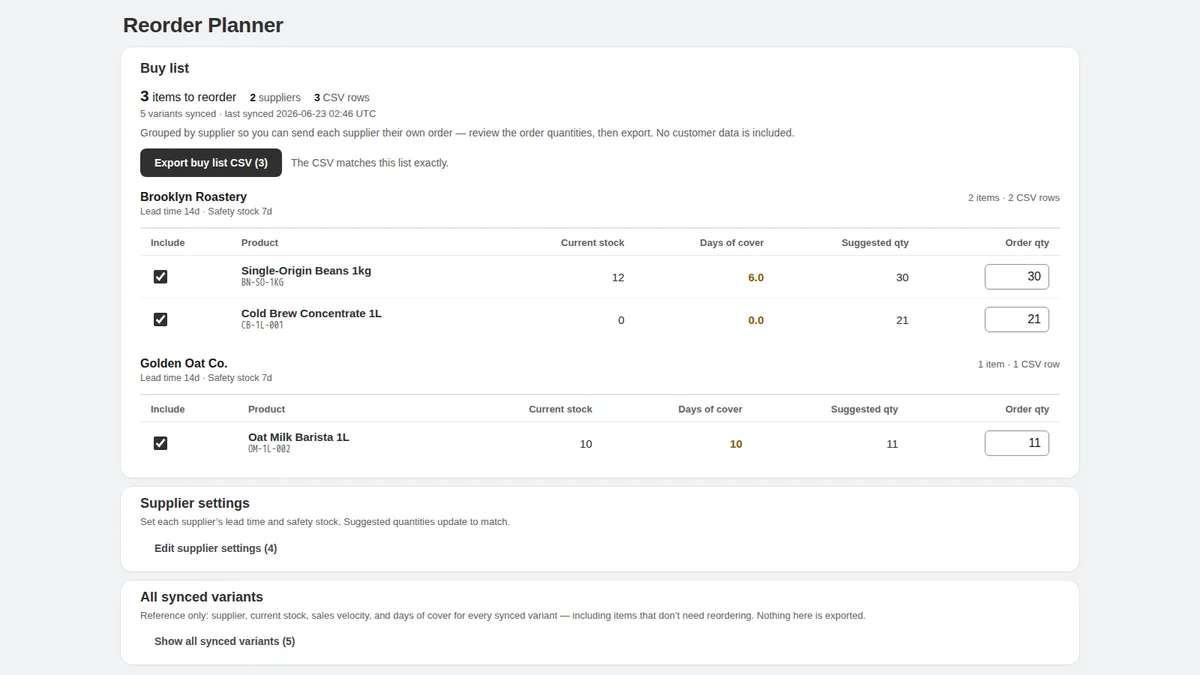
A buy list is a planning method, not a Shopify feature, and this guide is not meant to cover every workflow Stocky used to support. The buy list does not create Shopify purchase orders; those stay native to the Shopify admin, and the list only feeds the decision behind them. None of this is demand forecasting, and the reorder points and quantities you settle on are judgement calls a person reviews, not numbers to follow blindly. Supplier records and order history still need source-backed checks against your own store. For the buy-list step itself, Kijun Reorder Planner is one option, scoped honestly: it builds supplier buy lists from recent sales and stock, groups reorder items by supplier, and lets you adjust quantities before exporting — you can save buy lists for later, and export CSV/PDF buy lists when the numbers look right. It is read-only by design: no inventory write-back, no native Shopify purchase order creation, and no use of customer names, emails, phone numbers, addresses, or payment data. Kijun Reorder Planner is available on the Shopify App Store. Try Kijun Reorder Planner.
This article was drafted with AI assistance and checked against cited sources through kijun’s editorial workflow. Last updated: 2026-07-03.
Stocky and Shopify are trademarks of Shopify Inc. kijun is not affiliated with or endorsed by Shopify.